

2024 State of Working North Carolina: The Cost of Inaction is now available.
Introduction
Too often, when a public policy that benefits working people is proposed, the discussion among policymakers, employers, and other stakeholders focuses on the costs of implementing the policy. Meanwhile, the costs of not pursuing a pro-worker policy change—or quantifying the benefits we miss out on when a policy is not in place—receive little to no attention.
Strong workplace policies benefit working people, families, and the economy. In a society where sick workers can’t take time off, there is more spread of illness, workers lose wages, and the workplace is less productive. Without a strong minimum wage or adequate unemployment insurance benefits for jobseekers, working people are put in precarious situations in which they cannot fully participate in a robust economy. Without supportive policies like paid family and medical leave, workers must balance their need to pay the bills with the necessary work of caring for themselves or their loved ones—causing lost wages for workers, reduced labor force participation, and an overburdened care system.

“I don’t see anybody where I work trying to live extravagantly. We’re just trying to live a basic decent life. Food, shelter, those type of things.”
Mary Hill, Amazon worker in Raleigh, NC
In this report, we try to assess the impact of inaction on North Carolina’s working people and its economy, exploring the costs incurred and the benefits lost due to these gaps. This is not a comprehensive assessment; however, we focus on several major policy gaps impacting workers in our state. While state-specific data is not available for every issue we cover in this report, we highlight relevant policy research and adapt the analysis of that work to North Carolina’s workforce and economic context.
We also look at how structural deficiencies— low wages, a lack of paid sick days or paid leave, a failing care economy, a weak unemployment insurance system—disproportionately impact workers of color and women. For much of this country’s history, labor policy has excluded non-white workers and women from the full benefits of their labor, often intentionally. While most of the report focused on a range of quantifiable costs and benefits, we also try to highlight impacts that are impossible to put a price tag on—the human costs of inaction. We also suggest policy solutions – solutions that North Carolina workers and advocates have been pushing the legislature to act on for years.
Author’s Note
Some of the policy gaps discussed in this report may involve overlapping costs. For example, the lack of each of these policies impacts labor force participation, and therefore contributes to reduced economic output. We try to highlight one major cost per section. To the degree possible, the cost cited is mostly isolated to the specific policy gap being discussed.
Throughout the report we use the terms Hispanic and Latinx to remain consistent with the term used in the research source we cite. Additionally, the report refers to workers as men or women since in many data sources (including the U.S. Census Bureau’s Current Population Survey, which is heavily utilized in this report for analysis of wages and jobs), survey data is collected on binary sex only.
“So, you’re working more hours and you’re doing more work for less money. That’s not affordable for you to take care of your family, for you to buy food or clothes, or even to pay rent. So, people are losing their homes and people are becoming homeless. If they buy food, they can’t pay the rent. They pay the rent, they can’t eat.”
Christine Robinson, CNA in Raleigh, NC
Low-wage Work/Minimum Wage
Congress established the minimum wage in 1938 when it passed the Fair Labor Standards Act. The purpose of establishing a national wage floor was to stabilize the post-depression economy and protect the workers in the labor force” and “to aid the lowest paid of the nation’s working population, those who lacked sufficient bargaining power to secure for themselves a minimum subsistence wage.” 1 But the federal minimum wage no longer serves any of those purposes today because it has not kept up with inflation. The Economic Policy Institute (EPI) found that in 2022, the federal minimum wage adjusted for inflation was at its lowest point since 1956. 2 Until 1968, the minimum wage saw regular increases, keeping pace with both inflation and productivity. If that trend had continued, the minimum wage would be roughly $23 per hour today3—which is higher than the median wage in North Carolina for all workers in 2023. The costs to minimum wage workers—and the economy—of allowing the minimum wage to fall so far behind inflation and productivity are enormous.
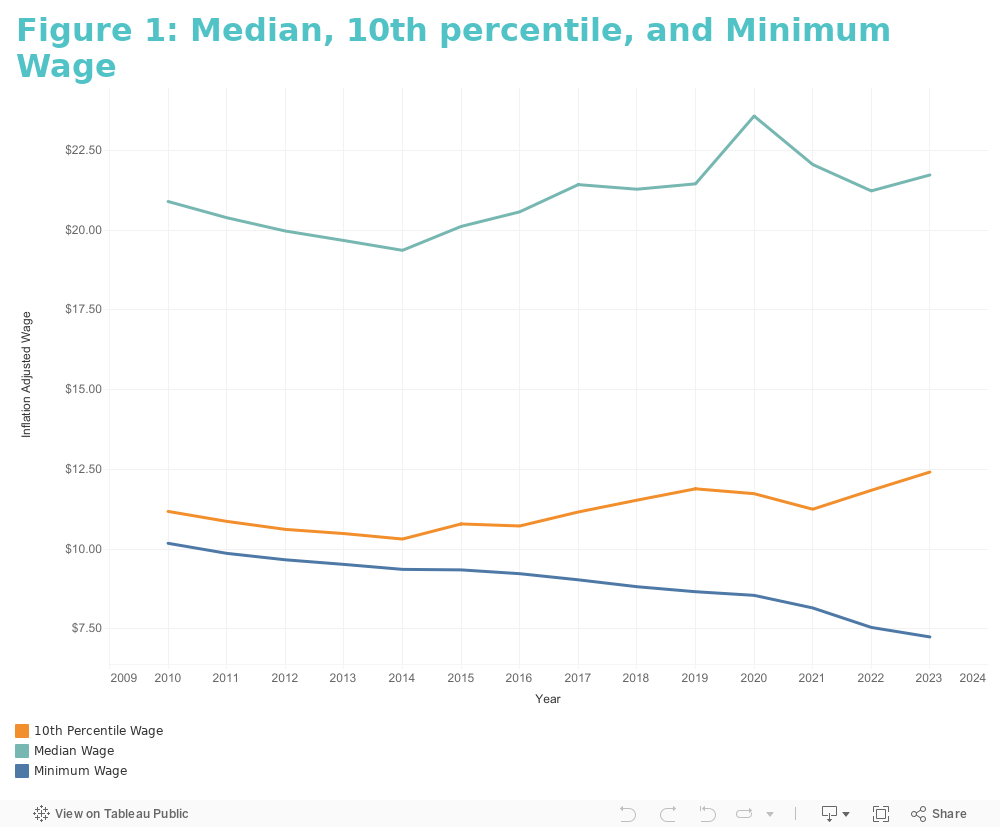
Figure 1 shows the progression of the median, tenth percentile, and minimum wages in North Carolina in real (inflation-adjusted) terms from 2010-2023. In real terms, wages have progressed very little, with most of the increase coming in the pandemic-era labor market. Between 2010 and 2023, the median wage has increased four percent from $20.90 to $21.73, the tenth percentile wage increased 11% percent from $11.19 to $12.42, and the real value of the minimum wage fell by 28.8 percent from $10.19 to $7.25, as the nominal minimum wage has not changed since July 2009.
While most states have enacted a minimum wage higher than the federal minimum wage, North Carolina is one of only 10 states with a minimum wage equal to the federal minimum. Nine of those ten states are in the Southern United States, reflecting what EPI describes as the “Southern Economic Development Model”.4 When policymakers fight against minimum wage increases, it is often under the assumption that a low minimum wage will bring jobs to the state and promote economic growth. The reality is that low wages slow economic growth by creating a class of low-wage workers who cannot participate fully in the economy. The long-term ramifications of this policy strategy are clear: the Southern region of the U.S. has the lowest Gross Domestic Product (GDP) per capita of any region. Job growth in Southern states lags behind the growth in the working-age population in other states, and labor force participation is lower in the Southern region than in other states.5
“The minimum wage needs to go up. Most people in don’t have anything to leave to their loved ones because [they are] so poor. They don’t have anything. So, you live, work, and die. That’s it.”
Christine Robinson, CNA in Raleigh, NC
For years, advocates in North Carolina have called for raising the minimum wage to $15 an hour; at this point, that amount would fall short of providing all workers with a livable wage and economic security. Several U.S. states and cities have set their minimum wage on a path to $15 an hour. Studies show that low-wage workers who benefit from a minimum wage increase spend a large proportion of their new wages on goods and services, stimulating the economy and benefiting both their communities and local businesses.6 Businesses also see benefits like decreased turnover, especially among small businesses and businesses in low-wage industries.7 Studies have generally debunked the myth that increasing the minimum wage leads to a decrease in jobs.8 Most businesses report little to no impact from minimum wage increases9, and researchers at EPI have even found that raising the minimum wage can result in a net increase in jobs due to the positive economic feedback effects of low-wage workers spending more money.10 When evaluating the impacts of a policy, economists will try to estimate an “economic multiplier”—the amount of economic activity generated by spending one additional dollar. The Institute for Policy Studies (IPS) estimates that every additional dollar earned by a low-wage worker generates $1.21 in additional economic activity.11
The adage, “It’s expensive to be poor,” best summarizes the costs to individuals with low-wage jobs. When workers live paycheck to paycheck and can’t afford necessities, it creates a cycle of precarity that can be impossible to escape. When low-wage workers and their families can’t afford healthcare or medicine, it can exacerbate long-term health problems, costing more in the long run. Often the basics are more expensive for people with low incomes. Energy costs, for example, are higher for people with low incomes because they tend to live in older, less energy-efficient homes and apartments, and energy upgrades are cost-prohibitive.12 Buying necessities like diapers is often cheaper if you can afford to buy in bulk, a luxury not available to parents living paycheck to paycheck.
“Everything’s gone up but our paychecks.”
Mary Hill, Amazon worker in Raleigh, NC
To make ends meet, workers often must find ways to cut costs for housing and transportation. In many cities where the cost of living has ballooned in recent years while wages have risen much more slowly, workers often cannot afford to live near their jobs. Low-wage workers also have more trouble finding reliable transportation, depending on an inexpensive used car that breaks down or a public transit system that offers few to no options in poorer and less central neighborhoods.
Low-wage workers disproportionately lack access to a vehicle. Roughly 13 percent of North Carolina’s extremely low-income workers—those earning below 30 percent of the Area Median Income (AMI)—lacked access to a vehicle, compared to roughly one percent of workers earning more than 120 percent of the AMI. Unemployed individuals of any income bracket were more likely to lack access to a car than their employed counterparts, but the difference was much starker for individuals with low incomes—roughly one in five extremely low-income workers lacked access to a car.13
Time spent commuting is also costly at an individual level. The U.S. Department of Transportation (DOT) guidelines for assessing economic costs and benefits of transportation projects recommend using a benchmark of $13.60 per hour of personal travel time saved. Adjusted for inflation, this equals about $17.90 in 2024.14 For a full-time worker, taking on an extra hour in round trip commuting time per day adds up to more than $4,500 per year in time costs.
The result of low wages and rising housing costs is that low-wage workers face longer commutes and are more likely to miss or be late for work due to unreliable transportation. This puts them at greater risk of losing their jobs and missing out on much-needed income. Workers who need to take multiple jobs have the additional obstacle of commuting between jobs. Some workers turn down work for which they would be well-suited because they cannot reliably commute, instead taking lower-paying jobs closer to home or spending more time looking for a job.
Low-wage jobs have a greater impact on working women and workers of color. The National Women’s Law Center analyzed the composition of low-paying jobs—defined as the 40 lowest-paying jobs nationally—for part-time and full-time workers.15 They found that in North Carolina, women make up 64 percent of workers in these low-paying jobs—more than 400,000 women in total. Analysis from EPI shows that 21.5 percent of all women workers earn less than $15 per hour. Among workers of color, 26 percent of Black workers and 33 percent of Hispanic workers earn below $15 per hour. This rate is more than double the rate for white workers (13 percent).16
“If you have a business, [paying a living wage] should be baked into your business plan. Your restaurant should not be built on extraction and making sure that you can pay the person who works for you as little as you legally can.”
Aaron Williams, Chef and Entrepreneur in Greensboro, NC

How much is this costing us?
According to analysis by EPI, increasing the minimum wage to $15 per hour would result in a wage increase for 1.2 million North Carolinians and increase total wages paid by about $3.75 billion in one year.17 A higher share of women workers (31 percent, compared to 21 percent among men) and workers of color (38 percent, compared to 19 percent of white workers) would see wage increases. Using the multiplier from IPS (1.21) referenced earlier in this section, a minimum wage increase to $15 per hour would result in about a $4.5 billion increase in the state’s economy.
“There ain’t no saving money to do things with my child. There ain’t really much. I don’t know, it just seems like I worked for nothing because it’s gone when you get it.”
Jamey Gunter, Fast food worker in Mars Hill, NC
Unemployment Insurance
Congress and President Roosevelt created the Unemployment Insurance (UI) system in 1935 as part of the Social Security Act. The initial policy motivation was to stabilize the economy during times of economic decline and mass layoffs and to lessen the economic impact of losing a job by providing temporary income to people who are unemployed through no fault of their own. North Carolina’s UI system, which has become one of the worst-performing in the country, is not meeting those objectives.
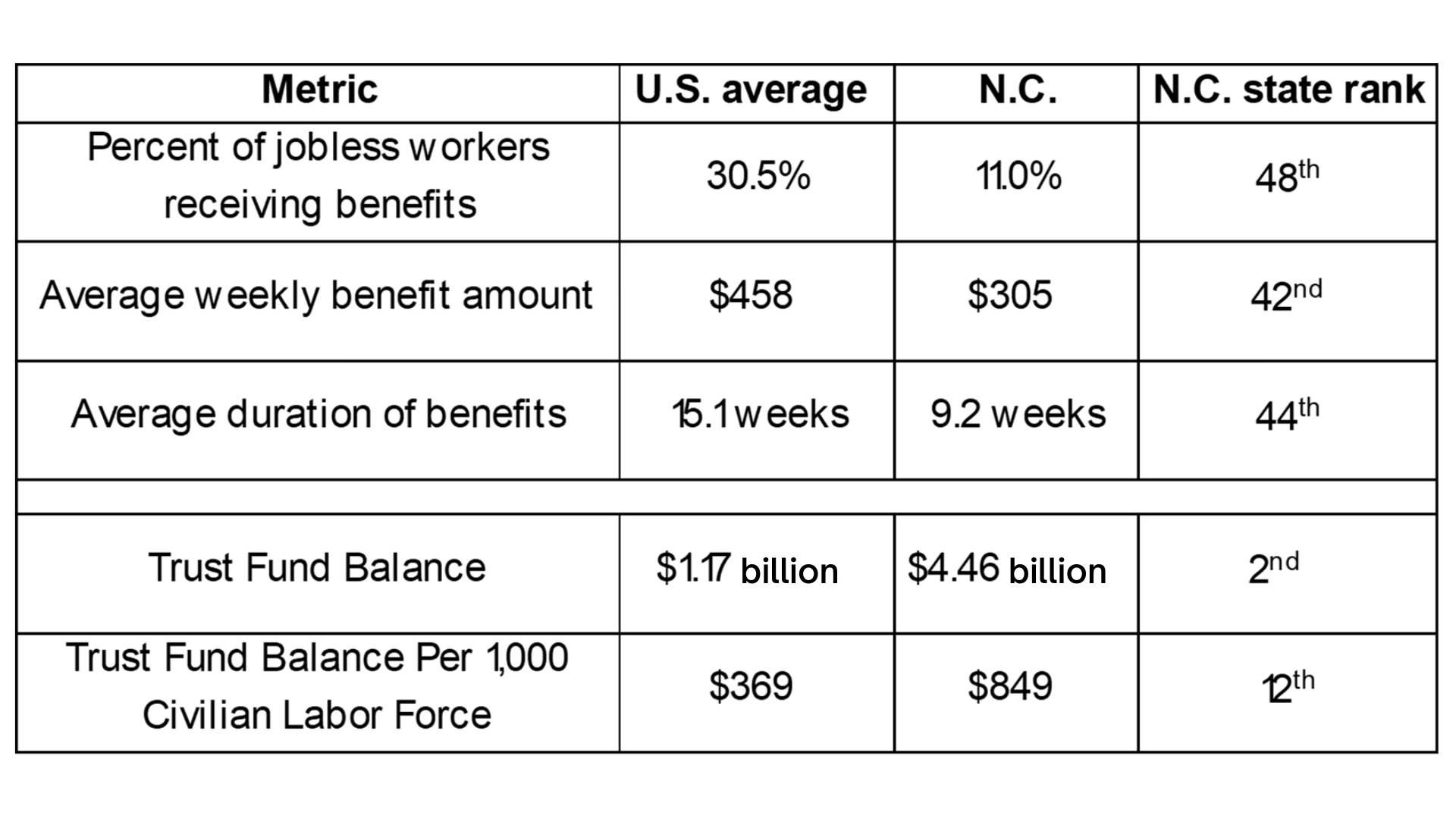
In 2013, North Carolina lawmakers permanently cut the amount, duration, and eligibility for benefits for all unemployed workers—the most severe cuts ever enacted by any state during the program’s 80-year history.18 North Carolina consistently ranks in the bottom five states for its low percentage of jobless workers who receive benefits and for its short average duration of benefits. The state also ranks among the ten worst states in terms of average weekly benefit amount.
These low rankings are not due to a lack of resources. North Carolina has one of the country’s largest UI trust fund balances, ranking twelfth among all 50 states in trust fund balance per person in the civilian labor force.
Table 1 – N.C. Unemployment Insurance metrics and rank among 50 states (1st quarter 2024)19
What does lack of UI mean for working people?
UI is an essential economic stabilizer, an insurance program that can prevent economic hardship both at an individual level and a societal level during periods of job loss or economic recession. UI replaces a percentage of a working person’s income. For low-income workers especially, it can be the income support that prevents a utility shut-off, a car repossession, an eviction, or other life-altering financial stressors during a period of unemployment.

During this time my landlord worked with me only because I had resources still available to help me pay the amount that was owed. Then he […] decided in June to raise the rent up to $875 a month. I had to fight and get housing assistance just so my son and I would not be homeless.”
Tonya Mills, Greensboro, NC
UI also promotes reemployment and helps to maintain a strong labor force. It is important for a healthy workforce that workers find jobs for which their skills and experience are well-suited and that employers find workers with the necessary skills to perform their job duties. The process of filling a job vacancy is long and often strenuous for both jobseekers and employers. Potential employees spend time searching job postings, sending out applications, and going to interviews, while potential employers spend resources evaluating their needs, writing job descriptions, reviewing applicants, and interviewing potential employees. When workers don’t have time to search for a job and UI benefits are inadequate, they may have to take the first work they can find. The resulting job mismatch is also costly to both workers and employers. Workers lose out on earnings and the opportunity for a job that is better for them, while employers miss out on qualified applicants and may struggle to find workers who can perform the job they are hiring for at a high level.
“[The low benefits] affected me a lot because if I had an interview, I didn’t have gas to get to that interview. Thank goodness a lot of them were virtual, but if I didn’t pay my bill, I couldn’t use the internet, which I needed for the job search.”
Tonya Mills, Administrative assistant in Greensboro, NC
Strong UI benefits are also an equity issue, as unemployment disproportionately affects women workers and workers of color. Unemployment rates for women are typically higher than for men. In 2023, the unemployment rate for men in North Carolina was 2.9 percent, compared to 3.6 percent for women.20 Over the last two decades, the unemployment rate was usually higher for women.21 The unemployment rate varies even more by race than by gender. In 2023, the average unemployment rate for Black women was 5.8 percent, and 4 percent for Black men. Research has shown longer benefit duration enables workers in households with low incomes—and in disproportionately Black and Latinx households—to spend more time searching for suitable work that matches their skills.22
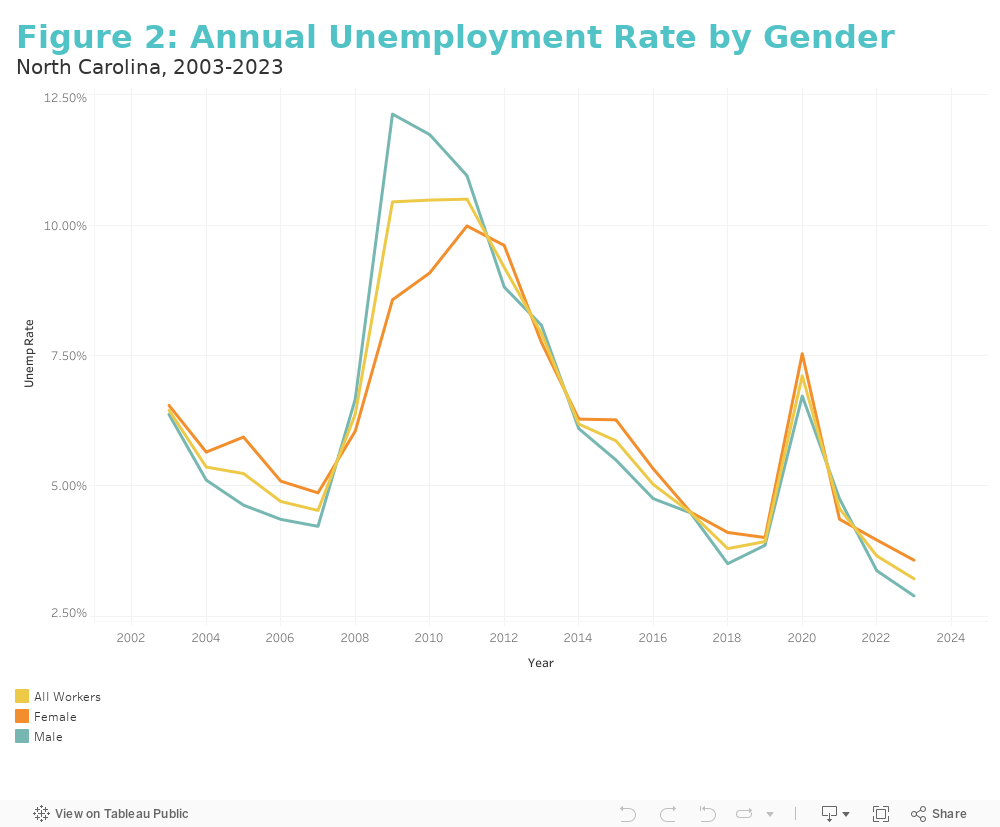
Data Source: Author’s analysis of Economic Policy Institute Current Population Survey Extracts, Version 1.0.55, https://microdata.epi.org.
Table 2 – Unemployment Rate in North Carolina by Race/Ethnicity and Gender, 2023 annual average

Source: Author’s analysis of Current Population Survey Basic Monthly Sample from Economic Policy Institute, Version 1.0.55, 2024. Accessed at: https://microdata.epi.org.
Cost to the state’s economy
In 2023, North Carolina paid out just $193.4 million in UI benefits, or about $37 per person in the civilian labor force over the year. The national average is more than five times that amount. If the recipiency rate, weekly benefit amount, and average duration of benefits in North Carolina rose to the national average, unemployed North Carolina workers would see an additional $825 million in benefits each year.
Less UI income means less economic activity. Feedback loops drive local economies when people have more money to spend, businesses grow and hire more people, who in turn spend more money and drive economic activity. Across several studies, economists have estimated the economic multiplier of increased UI benefits, and have found that for each additional dollar spent on UI benefits, there is nearly two dollars of increased economic output.23 Using a fiscal multiplier of 1.9, North Carolina’s economy is missing out on $1.57 billion in activity each year by not offering UI benefits similar to the national average.
Paid Leave
“I had a surgery, I had a colectomy done. I was entitled to 60% of my income while I was on my leave of absence. Short-term [disability], that’s what it was called, and I was getting $149.23 a week. That doesn’t even cover my rent, let alone my light bill, my gas bill, my water bill.”
Mary Hill, Amazon worker in Raleigh, NC
The vast majority of working people will need to take an extended leave of absence to recover from a health crisis, welcome a new baby, or care for a seriously ill or dying loved one at some point during their careers. However, only about 27 percent of American workers and 24 percent of working people in the South Atlantic census region have access to paid family and medical leave through their employers24. Paid leave supports working people by providing economic stability when taking time away from work during stressful periods of extended care. Giving parents time to bond with and care for young children has positive impacts on a child’s brain development and emotional stability25, leads to reduced infant mortality26, and improves maternal health outcomes.27 It benefits employers and the economy by increasing labor force participation and reducing turnover. Paid leave policies that guarantee workers the ability to recover and provide caregiving in serious health circumstances improve equity for workers of color, women workers of all races, and low-wage workers, groups that experience disproportionate harms as a result of the lack of access to these benefits.
Impacts at all stages of life
Elderly people and adults with disabilities rely on family members for care, and a lack of access to paid family and medical leave puts stress on both those needing care and their caregivers. In 2021, nearly 1.3 million North Carolinians were caregivers for family members suffering from chronic illnesses.28 Roughly 95 percent of adults living at home with a physical, cognitive, or chronic health condition rely on unpaid family caregivers for help with everyday activities, and for an estimated two out of every three of these adults, that unpaid care is their only source of help.29 The American Association for Retired Persons (AARP) found that in 2021, caregivers nationwide provided 36 billion hours of unpaid eldercare. This unpaid care was worth an estimated $600 billion across the U.S., including $16.5 billion in unpaid eldercare labor in North Carolina. Women did approximately 60 percent of this unpaid care work.
“Every family has these kinds of crises that demand caregiving. It’s not just for children, some people have elderly parents who also need caregiving and it’s a basic human right for everyone to have the flexibility to be able to attend to their family needs. It shouldn’t be a privilege.”
Ruhani Amin, Nonprofit worker in Greensboro, NC

Paid family leave is also critical for parents and children. A 2012 study found that nearly one in four U.S. moms returns to work within two weeks of giving birth30. Paid family leave gives new parents time to heal from childbirth, establish breastfeeding, and bond, strengthening the relationship between parent and child. Paid maternity leave also has numerous positive impacts on maternal health31, a critical concern in North Carolina, where maternal mortality rates doubled between 2019 and 2021.32 Maternal mortality is particularly high for Black women; nationally, Black women are 2.6 times more likely to die from pregnancy-related causes than white women.33 A study by Duke University researchers found that a paid family leave insurance program providing 12 weeks of leave would save an estimated 26 infant lives per year in North Carolina.34 In 2021, North Carolina’s infant mortality rate was 6.8 deaths per 1,000 live births, the 11th worst rate in the country.35,36 Infant mortality rates are disproportionately high among babies of color; infant mortality among Black babies (12.1 per 1,000 in 2021) is 137 percent higher than the infant mortality rate of white babies in North Carolina (5.1).37
The cost of not having paid leave
The lack of paid family and medical leave means workers miss out on critical moments with their families. Not having access to paid leave worsens the economic security and health of workers and their families, increases turnover, and reduces labor force participation. 38
Table 3 – Labor Force Participation Rate in North Carolina by Race/Ethnicity and Gender, 2023 annual average

Source: Author’s analysis of Current Population Survey Basic Monthly Sample from Economic Policy Institute, Version 1.0.55, 2024. Accessed at: https://microdata.epi.org.
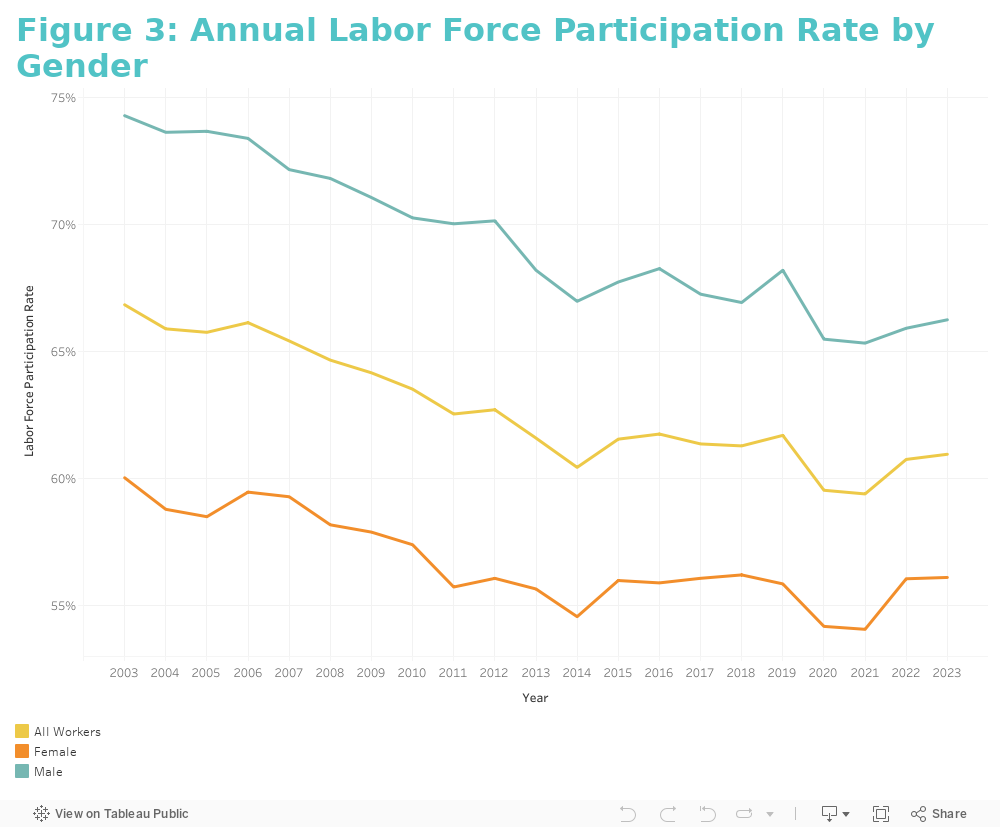
Source: Author’s analysis of Current Population Survey Basic Monthly Sample from Economic Policy Institute, Version 1.0.55, 2024. Accessed at: https://microdata.epi.org.
The Women’s Bureau of the U.S. Department of Labor analyzed the impact of not offering support for working parents in their 2023 publication “The Cost of Doing Nothing”.39 The United States is “a global outlier among comparable economies because it did not guarantee working parents the right to any paid days off from work to care for a new baby or a sick or injured family member.” Just 13 states and Washington, D.C. offer any paid family medical leave program. Among the 15 Organisation for Economic Co-operation and Development (OECD) countries with the highest GDP, the United States has the lowest labor force participation rate among women. If the labor force participation rate of women in the U.S. were similar to that of Germany or Canada—nations which both rank below average among the 15 OECD countries with the highest GDP—it would result in nearly 5 million more women in the workforce and a GDP increase of approximately 3.1 percent. A 3.1 percent increase in GDP for North Carolina would add approximately $23 billion to the state’s economy annually.40
Paid family leave would really help because it’s proven that if people have paid family leave with their jobs, they’re able to stay with that job longer. Infant care is the hardest to find. A lot of families want to be with that baby, want to have that time. So, giving workers that benefit would actually reduce the burden [on the childcare system], reduce the wait list for that tiny baby care – which is the most expensive to provide – and would also make it possible for more women to stay in the workforce after they have a baby.”
Rachel Shelton, nonprofit worker in Asheville, NC
Paid Sick Days
Roughly four in 10 working North Carolinians—approximately 1.6 million people—do not have access to paid sick leave.41 When workers cannot take time off from work when they are sick, it results in increased spread of illness, an increase in accidents at work, reduced productivity, lost wages, job losses and turnover, and worse health outcomes. Making sure workers can stay home and care for themselves and their loved ones when sick could drastically reduce negative health, safety, and economic impacts at individual and societal levels.
“My experience has been having COVID and having to be out for a week and a half because I didn’t want to get anyone else sick. In the back of my mind knowing that the bills are not stopping, the rent is going to come and I can’t even afford to go to the doctor, so I’m healing up at home. Knowing that at the end of the day, I’m going to be in a financial bind that I’m going to have to, after this is over, work harder to pull myself out of. [Not having paid sick days] is just putting people in continuous holes of debt.”
Aaron Williams, Chef and Entrepreneur in Greensboro, NC
What are the costs we could avoid?
When workers have to go to work sick or risk losing their jobs and incomes, it has consequences for everyone—the worker, their family, their employer, and the general public.
Employees who work while sick worsen their own health and can infect other workers and customers when they are sick with a contagious illness. When lawmakers implement paid sick leave policies, the spread of contagious illnesses and the number of workers coming to work sick decreases.42,43 One study found that implementing mandatory sick leave caused a net decrease in total sick leave taken by 18 percent,44 meaning that the additional sick leave available to workers who previously had none was more than completely offset by workers taking less sick leave. Another study found a 22 percent decrease in foodborne illnesses associated with paid sick leave laws.45 When sick workers stay home, we all benefit from reduced illness spread, and businesses and the economy benefit when people can come to work healthy and productive.

“[Working without sick time] was challenging. Financially we were okay because of my husband’s income. But it made me not as good of a worker. In teaching you have to be really present. It’s very demanding and if you’re out, it puts something on your other teammates. It’s not good for the kids who are in your classroom.”
Rachel Shelton, Nonprofit worker in Asheville, NC
While businesses incur a cost when they pay a sick worker who doesn’t come into the workplace, offering this economic security can benefit the business more in the long run. Paid sick leave is one of several worker-friendly policies that make employees less likely to leave for another job. The cost for a business to replace an employee averages around 20 percent of the employee’s salary. 46 Paid sick leave is one policy that can help reduce these turnover costs. The two industries with the highest voluntary quit rate—accommodations and food service—are also two of the industries with the lowest percentage of workers who receive paid sick time or other benefits.47 One study found that providing paid sick days decreased the probability of job separation by at least 25 percent.48
The costs on an individual level are more obvious. When workers can’t recover from illness and access healthcare for illness or preventative care, it leads to worse health outcomes. Paid sick days mean longer, healthier lives for working people, and reduced strain on the healthcare system, particularly for emergency services.49 When working parents can care for their sick children, children recover more quickly, are less likely to develop serious illnesses, and have improved overall health. Access to paid sick days makes children more likely to receive annual checkups and vaccinations. Sick days are also an important tool to prevent child abuse and neglect, as children of parents who have access to paid sick days are less likely to be placed with unsafe or unqualified caregivers.
“I had to go to the hospital one night. I couldn’t walk. Two managers got on both sides of me and carried me out to my car out the back door. I went to the hospital and come to work the next day, to find out I got wrote up for going to the hospital. It’s not right.”
Jamey Gunter, Food service worker in Mars Hill, NC
The lack of paid sick days policy is an equity issue. Low-wage workers (disproportionately women and people of color) are significantly less likely to have paid sick days. According to the Bureau of Labor Statistics, 60 percent of U.S. workers in the bottom tenth of income distribution and 42 percent of workers in the bottom quartile lack access to paid sick leave, compared to 21 percent of workers across all income levels.50
Cost to North Carolina businesses
The U.S. loses billions of dollars each year in both productivity losses and “presenteeism” as well as absenteeism from sick workers.51,52 Studies from the early 2000s estimate that health-related productivity loss costs U.S. employers between $150 billion and $260 billion annually, which can primarily be attributed to reduced performance at work due to illness or another health condition53 Adjusting these studies for inflation, the national cost of lost productive time is more like $250 billion to $370 billion in today’s dollars. Taking a midpoint of about $300 billion, and assuming that these costs in North Carolina are proportional to the state’s contribution to the national economy54, the costs come out to about $8.4 billion annually. As established earlier in this section, paid sick leave policies have been associated with benefits such as an 18 percent decrease in total sick leave taken and a 22 percent decrease in the spread of foodborne illnesses. Using these figures as a benchmark, we estimate a paid sick days policy could reduce the costs of worker illness to businesses by about 20 percent, saving North Carolina employers roughly $1.7 billion annually.
Care Economy
While expanding paid leave will allow many working North Carolinians to care for themselves and their families, ensuring that children and other loved ones have continued, long-term care requires access to professional caregiving. This is why care work is referred to by many as “the work that makes all other work possible”.55 By not supporting the care infrastructure in the ways other industrialized nations do, our care economy is not meeting the needs of those who rely on it, or those working within it.
Childcare
Quality, affordable, appropriate, and safe childcare options are essential to keeping parents in the workforce.56 In North Carolina, working parents face childcare shortages, particularly in rural areas, as well as an affordability crisis. Despite the high cost of childcare, wages for childcare workers remain low, and continued turnover threatens to worsen the long-term outlook for the childcare industry.
On average, center-based infant care in North Carolina costs $12,000 annually, or about 14 percent of a median-income family’s total earnings.57 While childcare is an exorbitant expense for families, it’s certainly not leading to well-paid childcare workers. The median hourly wage for childcare workers in North Carolina was just $13.99 per hour in 2023, and only 10 percent of childcare workers made more than $18.03 per hour.58 When childcare centers shut down during the pandemic, workers left the industry, and many found other work. Employment levels in the childcare industry have been slow to recover, exacerbating a longstanding crisis.
In a study by Council for a Strong America59, the childcare crisis was estimated to cost the U.S. $122 billion annually. This includes $78 billion in costs to parents, like lost earnings and time spent looking for work; $23 billion in costs to businesses from reduced revenues and extra hiring costs; and $21 billion to taxpayers in reduced income and sales tax revenues. The study also estimated that in North Carolina, the total cost of the childcare crisis in 2023—to parents, businesses, and taxpayers—was $3.5 billion.
Eldercare and other long-term care
Finding care for aging or disabled family members proves equally difficult. A Kaiser Family Foundation report found all states surveyed were experiencing a shortage of care workers, and most states experienced permanent closures of care providers in 2023, primarily concentrated in adult day health programs, group homes, and assisted living facilities.60 To counter the shortage, most states have increased Medicaid reimbursement rates, but wages in these facilities remain low. The additional burnout caused by the pandemic led many workers to quit61, a trend the industry has been slow to recover from.
In our 2022 and 2023 reports, we noted that the working conditions brought on by the pandemic resulted in significantly lower employment levels in almost every industry within the care economy. While many of these industries achieved modest recovery in 2023, most still fall behind 2019 levels despite increasing demand. The number of people employed in child day care services in North Carolina finally eclipsed 2019 levels for the first time in 2023, increasing by 2.6 percent. Employment levels are still below 2019 levels in home health care services (3.8 percent lower in 2023 than in 2019), residential mental health facilities (2.3 percent lower), and continuing care assisted living facilities (8.2 percent lower). The biggest gaps remained in skilled nursing care facilities (a 14.8 percent reduction from 2019), vocational rehabilitation services (16.6 percent lower) and “other” residential care facilities (16.7 percent lower), which generally describes residential facilities that provide a mix of supervisory, nursing, and other health and social services required by residents.
Table 4: Percent change in private sector annual average employment levels, 2019 to 2023, select industries

Source: Author’s analysis of the Bureau of Labor Statistics’ Quarterly Census on Employment and Wages (QCEW)
Most workers in the care economy are women. In North Carolina, more than 45 percent of workers in the nursing and residential care facilities industry are healthcare support workers, and healthcare support workers are predominantly Black women.62 The median wage for healthcare support occupations in nursing and residential care facilities in North Carolina is just $16.13.63
As the demand for caregiving continues to grow, the care economy will only become more strained. More than 1.86 million people over the age of 65 lived in North Carolina in 202264. The over-65 population has increased by nearly 40 percent since 2012, outpacing the growth of the total population by roughly 10 percent65. Nationally, the over-65 population is expected to nearly double between 2016 and 2060.66 Over their lifetimes, roughly two-thirds of today’s 65-and-over population will need long-term care.67
When I started out [in home care work], it was minimum wage, but there were private jobs that you could make good money. In the 80s, the 90s, and even the 2000s, I was making good money. Now the pay rate went back and now you are not making anything. You’re working like a dog and you’re working two or three jobs to make ends meet, and it’s still not enough for you because jobs are not paying what you are worth.”
Christine Robinson, CNA in Raleigh, NC
“I would just urge [lawmakers] to think about their own families. I’m sure if they don’t have children themselves, they have children around them…nieces, nephews, grandchildren. You want the best for the children in your family. Think about the elderly people in your family, whether it’s your grandparents or your own parents. You want them to also get the care that they need. Families are the basic foundation of our society. You want your family to be able to be its best, and to thrive. You are appointed by your constituents to create that world for all families, not just your own.”
Ruhani Amin, nonprofit worker in Greensboro, NC
The Human Cost of Inaction
In this report, we have focused primarily on analyzing the economic impact of our state’s lackluster workplace policy landscape, both to the state economy and to individual workers and households where possible. But many of the impacts to working North Carolinians are incalculable. For this section of the report, we interviewed eight working people from various sectors across the state about how low wages, inadequate unemployment benefits, the absence of paid family and medical leave and paid sick days, and an underfunded child and elder care system have affected them and their families.
The Interviewees:

Mary Hill
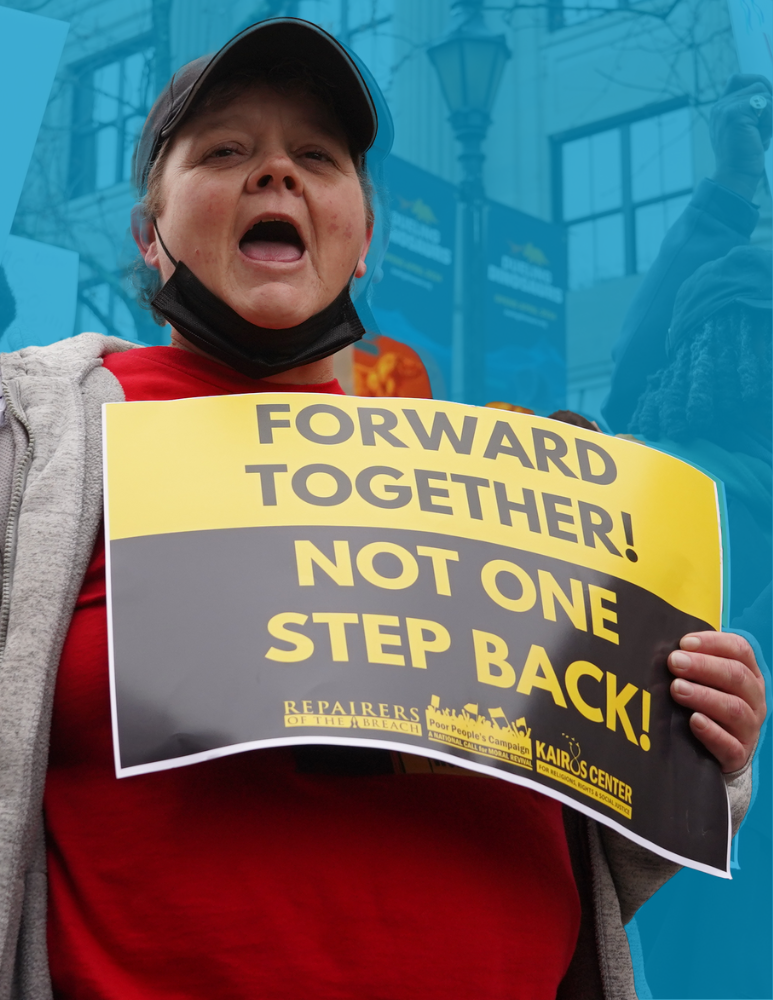
Mary is an Amazon worker living and working in Raleigh. Mary is a proud member of Carolina Amazonians United for Solidarity & Empowerment, the worker-led campaign to unionize Amazon workers.
Jamey Gunter
Jamey is a fast-food worker and mother of two working and living in Mars Hill, North Carolina, in the Appalachian Mountains. She is an active member of the Union for Southern Services Workers and has participated in worker-led actions to win greater rights for food service industry workers.
Tonya Mills
Tonya is a working mom of two who lives and works in Greensboro. Tonya has experienced multiple layoffs since 2020, resulting in nearly two years of unemployment.
Aaron Williams
Aaron is a food justice advocate, a chef, and an entrepreneur living and working in Greensboro. interview

Christine Robinson
Christine is a certified nursing assistant working in home- and community-based care in Raleigh. She is a leadership committee member with the National Domestic Workers’ Alliance.
Rachel Shelton
Rachel is a former public school teacher and mom of two living and working in Asheville. She now works as an advocate for early childhood learning.

Ruhani Amin
Ruhani is a nonprofit worker and a mother of three. She is a survivor of domestic abuse, and now works for a domestic violence prevention organization.

Dave*
Dave is a delivery driver living in the mountains of Western North Carolina. Dave has been involved in growing worker organizing efforts in his community.
*Name has been changed to protect interviewee’s anonymity.
Minimum Wage
Mary Hill works at an Amazon fulfillment center in Raleigh. She is dismayed at the low pay and poor benefits she and her coworkers receive doing item picking and packaging work.
“The last time we got a raise—they called it a raise, I called it a cost of living adjustment—it was $0.40,” Hill said. “So what did you really give me?”
Hill says the wealth accumulated by the company and its CEO should be shared with the people doing the work to keep the company functioning.
“Jeff Bezos will never be broke. His great-great-great-great-grand babies will never be broke, and he doesn’t want to pay the people,” Hill said. “If it weren’t for us, he wouldn’t have all these zeros behind his name.”
On the other end of the state Jamey Gunter, an Appalachian fast food worker, feels a similar frustration with the enormous wealth gap between CEOs and the workers who make their profits possible.
“We should not have to go without. We’re making their companies bigger. These corporations and franchises, they’re just killing people,” Gunter said. “They’re just killing them faster and they ain’t going to have no retirement. What are they going to save for retirement at $12 an hour? You can’t do it.”
Retirement is indeed out of reach for many older working North Carolinians, thanks in part to decades of depressed wages that mean lower earnings over a person’s working lifetime. Despite being well past retirement age, Hill continues to work due to her low social security earnings.
“I get my retirement, but it’s only $800 a month. That’s why I have to work. They try to talk you into waiting to full retirement, which I wished I could’ve, but at the time, I couldn’t. I had a job making ten dollars an hour, but it wasn’t that much money. I needed extra income. So I filed for my retirement.”
Now 70 years old, Hill is still working. She is involved with efforts to organize her workplace and is adamant that change is not optional but mandatory.
“We need to update this antiquated, inadequate system that’s been in place since forever, that’s no longer meeting the needs of working class people,” Hill said. “It’s no longer sufficient. It doesn’t work.”
“An extractive environment”
Greensboro resident Aaron Williams attended culinary school to make a career in food, but has since stepped back from the industry. He cited the low pay, lack of benefits, and poor treatment he experienced and witnessed working in restaurants as the motivating factors behind his career change.
“Right now, I think that the food service industry is not a place […]people can really be proud and do what they love,” Williams said. “Because you have people who love to be a bartender, to be front of house or work the line, you know? But they might not stay long because of the [low] wages.”
Williams feels the low pay and lackluster benefits are pushing skilled, passionate workers out of the restaurant industry. “It’s honestly just really sad” Williams said. “It’s […] this extractive environment where people that love it can’t fully put their heart and soul in it because at the end of the day, it’s not giving you all the things that you need to be a full person.”
Working while homeless
Christine Robinson works in home care as a certified nursing assistant. She has cared for elderly patients and adults with disabilities for nearly 40 years. Robinson has felt the impact of stagnating wages, and recalls a time when care work afforded a decent living.
“When I started out [in home care work], it was minimum wage, but there were private jobs that you could make good money. In the 80s, the 90s, and even the 2000s, I was making good money” Robinson said. “Now the pay rate went back and now you are not making anything. You’re working like a dog and you’re working two or three jobs to make ends meet.”
Robinson is one of a rising number of North Carolinians experiencing homelessness due to high housing costs and low wages.
“Rent out there now is 1,500 to 2,200 dollars a month. I can’t afford it because I don’t make enough money on my job to afford the affordable housing,” Robinson said. “I’m homeless now because I don’t make enough money to pay for rent.”
Robinson has been staying at local shelters in the area, but the strict curfews and other rules in place for shelter seekers are often at odds with the demands of her job. She is currently waiting to find out whether she will be able to move into an affordable unit in an apartment complex for older adults. She expressed exhaustion at the lack of support.
“In this society, it’s a sin to be poor. It’s a crime,” Robinson said. “It’s a crime to be living in poverty, and there’s no relief for you.”
She feels an increase to the minimum wage is urgently needed for individuals and families in her situation. Robinson is exasperated by critics of a wage increase who claim it will increase inflation.
“Right now, a burger costs more than what I make an hour. So, inflation is now,” Robinson said.
Unemployment Insurance
Tonya Mills is a working mom living in Greensboro. Since the start of the COVID-19 pandemic, she has experienced two layoffs that resulted in nearly two combined years of unemployment. Mills has a Master of Business Administration, but due to the state’s inadequate unemployment insurance benefits and the lack of workplace supports for family caregivers, she is currently underemployed.
Mills nearly lost housing for herself and her nine-year-old diabetic son after her second layoff.
“I went from making about $1800 a month to making about $260 a month on unemployment,” Mills said. “It was really challenging. My rent was already $725, which when I was working a higher wage job, was easier to pay.”
“I had to use every resource I had. Now, after April [when my unemployment ran out], from May to August, it was a bear. I had to just keep promising my landlord that I would eventually pay him for him to keep us in there,” Mills said. “He sent me an email, and he was like, ‘This will not happen again. You will not get behind.’”
Mills said the short duration and low amount of unemployment benefits limited her job search and made her more frantic to accept whatever job she could find, even if it didn’t allow her to use her degree or provide the pay and benefits she needed.
“[Having inadequate unemployment benefits] affected me a lot because if I had an interview, I didn’t have gas to get to that interview,” Mills said. “Thank goodness a lot of them were virtual, but if I didn’t pay my bill, I couldn’t use the internet, which I needed for the job search.
Mills eventually found a part-time position working as an administrative assistant for a public school. While she feels grateful for the job and for the flexibility it affords her to care for her son’s medical needs, she is acutely aware of how little room for error there is in her family’s financial picture.
“I’ve always been a hard worker. I’ve always been able to maintain and take care of not only myself but my children,” Mills said. “This is a different atmosphere for me, an atmosphere that I don’t like. It scares me, but I know I have to move forward and do the best I can with what I have right now.”
Paid Family and Medical Leave
During her time working at Amazon, Hill was diagnosed with cancer, which involved multiple surgeries over a two-year period, followed by chemotherapy treatments.
“I have a port where they give me the chemo. It’s this little thing in my chest up here, and they hook it up,” Hill said. “I still have to go to work with the port. I can’t afford not to, you know what I’m saying? I’d be homeless probably in a month with all my bills.”
Initially, Hill received temporary disability, a voluntary program some employers offer that allows an employee to take time off with partial pay for medical situations. But the low benefits made it challenging for her to be able to rest and focus on her recovery.
“I was entitled to 60 percent of my income while I was on my leave of absence”, Hill said. “Short-term [disability], that’s what it was called, and I was getting $149.23 a week. That doesn’t even cover my rent, let alone my light bill, my gas bill, my water bill.”
Hill says working while undergoing cancer treatment is especially challenging because her job is a physical one.
“Some days with the chemo, it’s up and down. I don’t always feel good. The nausea and the fatigue are the main thing. At Amazon, you don’t need to be fatigued because we’re pulling totes, we’re moving items,” Hill said.
For many other working people in our state, there is no support whatsoever in the event of a medical crisis. While working for fast food chains in the Madison County area, Gunter required multiple medical interventions related to a heart condition with no access to paid leave for her recovery.
“It was scary because I didn’t know where the next dollar was going to come from,” Gunter said. “If I had paid leave, it would’ve helped out. I could have bought food, I could have bought gas, and medicines.”
Elsewhere in the North Carolina mountains, Dave, who works as a delivery driver, keeps tabs on what the lack of paid leave recently meant for his financial situation.
“I had a detached retina, an eye problem, which, if left untreated for more than a few days, could lead to blindness,” Dave said. “The cost of the surgery and the lost work time was about $2,000.”
Hill is eager to see employers start investing in the well-being of their employees with policies like paid leave.
“We need to update this antiquated, inadequate system that’s been in place since forever, that’s no longer meeting the needs of working-class people,” Hill said. “It’s no longer sufficient. It doesn’t work.”
Paid Sick Days
The COVID-19 pandemic served as a devastating example of the importance of allowing working people to stay home when sick. In 2020, in response to the crisis, Congress approved the first-ever national paid sick days program, providing paid time off for people who contracted the virus to rest and recover. The program expired at the end of 2020, even though the virus is still making workers sick and even claiming lives. For low-income workers, in particular, the impacts of a COVID-19 diagnosis are costly.
“I contracted COVID earlier this year and lost 10 days of work”, Dave said. “So, that’s about $1400.”
Williams also recently contracted COVID-19, and felt it was important to protect his colleagues and clients by staying home even though he had no paid sick time.
“The bills are not stopping,” Williams said. “I’m going to be in a financial bind that I’m going to have to, after this is over, work harder to pull myself out of. [Not having paid sick days] is just putting people in continuous holes of debt.”
Caring for others
Paid sick days are also an instrumental policy support for working family caregivers. Mills is explicit about her son’s health being her first priority.
“I have a Type 1 [diabetic] son who has additional special needs that I have to accommodate. And there may be days, even [working part-time], if he gets sick, I have to take off.”
Rachel Shelton, a former school teacher, recalled the challenges of balancing her child’s health needs with work demands when she was a new mom. Shelton had her children before the implementation of a policy that provided paid parental leave for teachers, and was forced to use up her sick days for childbirth and recovery.
“My older son had RSV as an infant. He was okay, but every time he got a cold when he was a baby, he had to have breathing treatments,” Shelton said. “It was really stressful. I ended up missing a lot of work without having a lot of sick time.”
Shelton also felt that the lack of paid sick time and the related pressure she was under impacted her performance as a member of her teaching team.
“It made me not as good of a worker. In teaching, you have to be really present,” Shelton said. “It’s not good for the kids who are in your classroom.”
Eventually, like many working parents, Shelton left the workforce altogether in part due to the lack of paid sick days.
“I got pregnant with kiddo number two, and I ended up stepping away [from my job] just because it didn’t seem worth it,” Shelton said. “I just didn’t have the sick time. It’s not what I would have chosen, but we just didn’t see a way to make it work.”
Care Economy
Beyond the lack of paid sick days, the lack of available childcare was the other part of the equation that led to Shelton’s decision to leave the workforce. She experienced North Carolina’s childcare crisis firsthand during her first pregnancy.
“I just was so excited to be pregnant and started telling some coworkers, and they were like, ‘Have you gotten on any waitlists yet?’” Shelton said. “Didn’t even start with congratulations. But I quickly learned they were right.”
When Shelton was ready to return to work, her family still had not secured childcare for the new baby, so they relied on her parents to care for him while she worked.
“We were still on all these wait lists,” Shelton said. Every six months or so, we’d get an email from some of the centers, like, ‘You are number 35 on the infant classroom wait list’, which has eight children in it.”
Shelton eventually left teaching altogether when she became pregnant with her second child. Motivated by her experiences, she became an advocate for affordable, accessible childcare for North Carolina families.
“Parenting is hard. No one expects parenting to be easy, but this part should be easier,” Shelton said. “You should be able to find a safe place for your kid to go where they’re going to learn while you’re at work. That just seems simple to me.”
Hill also sees her colleagues struggling to find affordable care for their young children. She recalled an incident over the summer in which a women working at another Amazon facility left her sick eight-year-old in the car because she was unable to find childcare and could not afford to miss work. Her child died of heat exposure after apparently turning off the air conditioning while her mother was working. Hill said she and her coworkers were stunned to discover that Amazon’s corporate headquarters in Seattle offered a daycare service—for employees’ pets.
“Why can’t we have a daycare or some sort of an allowance or voucher money-wise so that [parents] can afford the daycare,” Hill said. “But you can have a doggy daycare at corporate. Really?”
The elder and adult care sector is experiencing a parallel crisis, with low wages and poor benefits leading to higher turnover and a worker exodus from the direct care workforce. Robinson said her experience as a CNA homecare worker who can’t afford housing on her earnings is illustrative of the state of the industry.
“Some places are still paying $10 and $12 an hour,” Robinson said. “There is no way. You can’t make it. That’s why so many people are living in such poor conditions because they are not making enough money to live.
Robinson said lawmakers need to act to ensure that direct care workers are compensated adequately for their critical work.
“Put yourself in our shoes and see how you feel. If you come and try what we’re going through, I bet you would go back and change the way things are,” Robinson said. “So, you imagine millions of people out here; this is what we go through every day. We are human just like you, and we want to have a life and enjoyment and live to be comfortable just like the next person.”
Conclusion
North Carolina consistently ranks as one of the worst states for workers.68 To meet the needs of working people, grow our economy, and reap the economic benefits of good workplace policy, we need to invest in workers, families, and the people of our state.
We highlight some major costs of not having pro-worker policies:
- By not having a minimum wage of at least $15 per hour, we are missing out on nearly $4.5 billion per year that could be circulating in our state’s economy.
- By maintaining an Unemployment Insurance program that provides benefits well below the national average, we are missing out on another $1.6 billion annually in economic activity.
- Not having paid sick days costs businesses in North Carolina roughly $1.7 billion per year due to lost productivity and increased spread of illness.
- The lack of investment in our childcare system in North Carolina costs parents, businesses, and taxpayers an estimated $3.5 billion per year.
- The low rate of women’s labor force participation, driven by a lack of paid family and medical leave and other crucial policies, costs our state approximately $23 billion in economic output each year.
These costs are not comprehensive, but they represent a tremendous impairment to our state’s economic potential and that of its working people. And beyond these aggregate measures of economic and financial cost, there are numerous human costs to not having pro-worker policies that are difficult – or impossible — to put a price tag on.
Building the economy means investing in the resilience of workers. Labor policy in our state has been dictated by cost-cutting measures ostensibly aimed at attracting businesses, as well as policy grounded in a suspicion of workers or anyone seeking public assistance. This disregard for working people, the unwillingness to invest in programs that support them and their families, and the inability to recognize the clear benefits of a properly supported workforce mean many North Carolinians are subsisting in poverty. Beyond that, these measures also fail to achieve their goal of a robust economy. To build a strong economy that works for everyone requires investment and long-term vision. The alternative—inaction—costs us far too much, and gives us all too little.
Appendix: Policy Solutions
Improve wages and benefits for workers so that they can meet the needs of their families.
- Raise the North Carolina minimum wage.
- Ensure everyone in North Carolina has access to paid family and medical leave and a minimum number of paid sick days to care for themselves, sick children, and other loved ones.
- Adopt a kin care policy clarifying that workers can use existing paid or unpaid sick time for preventative healthcare and family caregiving needs.
- Pass a safe time policy allowing workers who are survivors of sexual assault, domestic violence, and stalking to use their existing paid or unpaid sick time to seek necessary services and support. Women make up a large majority of those who survive these acts of violence.
- Establish an inclusive family definition in any paid leave, paid sick days, kin care, and safe time legislation.
- Adopt fair scheduling requirements to ensure workers receive timely, clear information regarding their working hours.
- Ensure equal pay for workers doing substantially similar work regardless of gender or race.
- Establish pay transparency by requiring employers to disclose salary ranges for publicly posted job openings.
- Adopt salary history bans prohibiting employers from requiring information about candidates’ pay in prior jobs.
Increase public investment in direct care services.
- Invest in ongoing childcare stabilization grant funding to prevent facility closure and support a robust childcare workforce.
- Increase funding for childcare subsidies to reduce the waitlist for working parents seeking childcare financial assistance.
- Raise the reimbursement rate for direct care services provided through Medicaid.
- Require a portion of the increased funding to be used to improve worker pay and benefits.
Reform North Carolina’s Unemployment Insurance program to support workers and insulate the broader economy.
- Increase the duration for receiving benefits to 26 weeks.
- Increase the weekly benefit amount.
- Restore the maximum weekly benefit amount; index it to the state’s wage growth.
- Keep workers employed by establishing a work-sharing option for employers.
- Increase the earnings allowance/disregard.
- Re-establish eligibility for leaving work because of family hardship.
- Repeal waiting weeks for benefits.
- End overpayment collections when claimant is not at fault.
- Ensure language access for claimants with limited English proficiency.
Ensure that workers have the ability to impact their working conditions through collective bargaining and the freedom to move between jobs.
- Increase job mobility by limiting the use of restrictive employment agreements.
- Ensure the rights of all private employees to engage in collective bargaining to improve their workplaces.
- Establish collective bargaining rights for public employees.
References
1 Cornell Law School. Minimum wage. Legal Information Institute. https://www.law.cornell.edu/wex/minimum_wage.
2 Cooper, David, et al. “The Value of the Federal Minimum Wage Is at Its Lowest Point in 66 Years.” Economic Policy Institute, 14 Jul. 2022, www.epi.org/blog/the-value-of-the-federal-minimum-wage-is-at-its-lowestpoint-in-66-years/. Accessed 20 Aug. 2024.
3 Baker, Dean. “CORRECTION: $23 per Hour Minimum Wage? How Our Economy Broke the Link between Minimum Wage and Productivity.” Center for Economic and Policy Research, 18 Aug. 2021, https://cepr.net/press-release/26-per-hour-minimum-wage-how-our-economy-broke-the-link-betweenminimum-wage-and-productivity/. Accessed 20 Aug. 2024.
4 Childers, Chandra. “Rooted in Racism and Economic Exploitation: The Failed Southern Economic Development Model.” Economic Policy Institute, 11 Oct. 2023, www.epi.org/publication/rooted-in-racism. Accessed 20 Aug. 2024.
5 Childers, Chandra. “Breaking down the South’s Economic Underperformance: Rooted in Racism and Economic Exploitation: Part Two.” Economic Policy Institute, 11 Jun. 2024, www.epi.org/publication/rootedracism-part2/. Accessed 20 Aug. 2024.
6 Roberts, Lily, and Ben Olinsky. “Raising the Minimum Wage Would Boost an Economic Recovery—and Reduce Taxpayer Subsidization of Low-Wage Work.” Center for American Progress, 27 Jan 2021, https://www.americanprogress.org/article/raising-minimum-wage-boost-economic-recovery-reduce-taxpayer-subsidization-low-wage-work/. Accessed 20 Aug. 2024.
7 Wursten, Jesse and Michael Reich. “Small Businesses and the Minimum Wage.” Institute fo Research on Labor and Employment (IRLE) Working Paper No. 102-23, 7 Mar. 2023, https://irle.berkeley.edu/publications/working-papers/small-businesses-and-the-minimum-wage/
8 Roberts, Lily, and Ben Olinsky. “Raising the Minimum Wage Would Boost an Economic Recovery—and Reduce Taxpayer Subsidization of Low-Wage Work.” Center for American Progress, 27 Jan. 2021, www.americanprogress.org/article/raising-minimum-wage-boost-economic-recovery-reduce-taxpayer-subsidization-low-wage-work/. Accessed 20 Aug. 2024.
9 Ibid
10 Cooper, David , and Douglas Hall. “How Raising the Federal Minimum Wage Would Help Working Families and Give the Economy a Boost.” Economic Policy Institute, 14 Aug. 2012, www.epi.org/publication/ib341-raising-federal-minimum-wage/. Accessed 20 Aug. 2024.
11 Anderson, Sarah. “Wall Street Bonuses and the Minimum Wage.” Institute for Policy Studies, 12 Mar. 2014, www.ips-dc.org/wall_street_bonuses_and_the_minimum_wage/. Accessed 20 Aug. 2024. via Ibid (Roberts and Olinsky).
12 Pedersen, Leila, and Andrea Dreier. “Paying for Energy Costs Harder for Families Living in Poverty – North Carolina Justice Center.” North Carolina Justice Center, 14 Nov. 2019, www.ncjustice.org/publications/paying-for-energy-costs-harder-for-families-living-in-poverty/. Accessed 20 Aug. 2024.
13 Mengedoth, Joseph. “Transportation Access as a Barrier to Work | District Digest | Richmond Fed.” www.richmondfed.org, Federal Reserve Bank of Richmond, 2023, www.richmondfed.org/publications/research/econ_focus/2023/q4_district_digest. Accessed 20 Aug. 2024.
14 “Revised Departmental Guidance on Valuation of Travel Time in Economic Analysis | US Department of Transportation.” www.transportation.gov, US Department of Transportation, 27 Sept. 2016, www.transportation.gov/office-policy/transportation-policy/revised-departmental-guidance-valuation-travel-time-economic. Accessed 20 Aug. 2024. Adjusted using from June 2014 to June 2024 dollars using “CPI Inflation Calculator.” Bls.gov, Bureau of Labor Statistics, 2024, www.data.bls.gov/cgi-bin/cpicalc.pl?cost1=13.60&year1=201506&year2=202406. Accessed 20 Aug. 2024.
15 Tucker, Jasmine, and Julie Vogtman. “Hard Work Is Not Enough: Women in Low-Paid Jobs.” National Women’s Law Center, Jul 2023, https://nwlc.org/wp-content/uploads/2020/04/%C6%92.NWLC_Reports_HardWorkNotEnough_LowPaid_2023.pdf. Accessed 20 Aug. 2024
16 Unpublished analysis by the Economic Policy Institute for the North Carolina Justice Center. Projections based on American Community Survey (ACS) 2015-19 5 year estimates and demographic distributions from the 2022 Current Population Survey (CPS). For more details see Technical Methodology by Dave Cooper, Zane Mokhiber, and Ben Zipperer. https://www.epi.org/publication/minimum-wage-simulation-model-technical-methodology/
17 Ibid
18 Rowe, Bill, and Andrea Dreier. “Unemployment Insurance Changes Needed in North Carolina.” North Carolina Justice Center, 15 Mar. 2021, www.ncjustice.org/publications/unemployment-insurance-changesneeded-in-north-carolina/. Accessed 20 Aug. 2024.
19 Author calculations using “Unemployment Insurance Data”. U.S. Department of Labor – Employment and Training Administration, created: 29 Mar. 2004, updated: 14 May 2024, https://oui.doleta.gov/unemploy/data_summary/DataSum.asp. Accessed 24 Jul. 2024.
20 Author’s analysis of Current Population Survey Basic Monthly Sample from Economic Policy Institute, Version 1.0.55, 2024. Accessed at: https://microdata.epi.org.
21 Ibid
22 Chetty, Raj. “Moral Hazard versus Liquidity and Optimal Unemployment Insurance.” Journal of Political Economy, vol. 116, no. 2, Apr. 2008, pp. 173–234, https://doi.org/10.1086/588585. via “Benefit Duration – National Employment Law Project.” National Employment Law Project, 8 Nov. 2023, www.nelp.org/insights-research/benefit-duration/. Accessed 20 Aug. 2024.
23 Marco Di Maggio, & Kermani, A. (2016). The Importance of Unemployment Insurance as an Automatic Stabilizer. National Bureau of Economic Research, https://www.nber.org/papers/w22625. This paper estimates a local fiscal multiplier of 1.9. We will use this multiplier later in this section. Other estimates include: Vroman, W. (2010). The Role of Unemployment Insurance as an Automatic Stabilizer during a Recession. In DOL.gov. IMPAQ International, LLC. https://www.dol.gov/sites/dolgov/files/ETA/publications/ETAOP2010-10.pdf. Estimates multiplier of 2.0 for both regular and extended benefits. Kekre, R. (2022). Unemployment Insurance in Macroeconomic Stabilization. The Review of Economic Studies. https://doi.org/10.1093/restud/rdac080. Estimated multipliers between 0.6 and 1.8, depending on monetary policy conditions. Multiplier is larger when UI is expected to be extended over a longer time horizon, when a fixed interest rate is in place. Hellwig, K.-P. (2021). Supply and Demand Effects of Unemployment Insurance Benefit Extensions: Evidence from U.S. Counties. IMF Working Papers, 2021(070). https://doi.org/10.5089/9781513572680.001.A001. Estimates a multiplier of 1.92.
24 “National Compensation Survey: Employee Benefits in the United States, March 2023” U.S. Bureau of Labor Statistics (2023). . https://www.bls.gov/ebs/publications/employee-benefits-in-the-united-states-march-2023.htm.
25 Zigler, E., Muenchow, S., & Ruhm, C.J. “Time Off With Baby: The Case for Paid Care Leave.” Washington, DC: ZERO TO THREE (2012).
26 Gassman-Pines, Ana, and Elizabeth O. Ananat. “PAID FAMILY LEAVE IN NORTH CAROLINA: An Analysis of Costs and Benefits”. Center for Child and Family Policy, Sanford School of Public Policy at Duke University Mar. 2019, https://duke.app.box.com/s/9wti16byhdyyz6k99ri2yib3ttlprgl8. Accessed 20 Aug 2024.
27 Aitken, Zoe et al. “The maternal health outcomes of paid maternity leave: A systematic review”. Social Science & Medicine (2015) DOI:: 10.1016/j.socscimed.2015.02.001
28 Reinhard, Susan C., Selena Caldera, Ari Houser, and Rita Choula. “Valuing the Invaluable 2023 Update: Strengthening Supports for Family Caregivers”. AARP Policy Institute, Mar. 2023, https://www.aarp.org/content/dam/aarp/ppi/2023/3/valuing-the-invaluable-2023-update.doi.10.26419-2Fppi.00082.006.pdf. Accessed 20 Aug 2024.
29 Ibid
30 Lerner, Sharon. The Real War on Families: Why the US Needs Paid Leave Now. In These Times, 18 Aug. 2015, https://inthesetimes.com/article/the-real-war-on-families. Accessed 20 Aug 2024.
31 Aitken, Zoe et al. “The maternal health outcomes of paid maternity leave: A systematic review”. Social Science & Medicine (2015) DOI:: 10.1016/j.socscimed.2015.02.001
32 Bonner, Lynn. “NC maternal death rate exceeds national rate”. NC Newsline,17 Mar. 2023, https://ncnewsline.com/briefs/nc-maternal-death-rate-exceeds-national-rate/. Accessed 20 Aug 2024.
33 Ibid
34 Ibid, Gassman-Pines and Ananat https://duke.app.box.com/s/9wti16byhdyyz6k99ri2yib3ttlprgl8. Accessed 20 Aug 2024.
35 NC State Center for Health Statistics “2021 NORTH CAROLINA INFANT MORTALITY REPORT, TABLE 1A Infant Death Rates (per 1,000 live births), 2021”. North Carolina Department of Health and Human Services (2023), https://schs.dph.ncdhhs.gov/data/vital/ims/2021/2021-IMR-TABLE-1A-FINAL.html. Accessed 20 Aug. 2024.
36 National Center for Health Statistics. “Infant Mortality Rates by State”. Center for Disease Control and Prevention, 12 Sep 2023, https://www.cdc.gov/nchs/pressroom/sosmap/infant_mortality_rates/infant_mortality.htm. Accessed 20 Aug 2024.
37 Ibid, NC Center for Health Statistics
38 Romig, Kathleen, and Kathleen Bryant. “A National Paid Leave Program Would Help Workers, Families.” Center on Budget and Policy Priorities, 27 Apr. 2021, www.cbpp.org/research/economy/a-national-paid-leave-program-would-help-workers-families. Accessed 20 Aug. 2024.
39 Glynn, Sarah Jane. “The Cost of Doing Nothing, 2023 Update: The Price We STILL Pay without Policies to Support Working Families”. US DOL Women’s Bureau, Nov. 2023, https://www.dol.gov/sites/dolgov/files/WB/paid-leave/CostofDoingNothing2023.pdf. Accessed 20 Aug 2024.
40 Author’s calculations based on “Gross Domestic Product: All Industry Total in North Carolina”. Federal Reserve Bank of St. Louis: FRED Economic Data, updated 23 May 2024, https://fred.stlouisfed.org/series/NCNGSP. Accessed 23 Aug 2024. State GDP was 766.919 billion in 2023, 3.1% of that is 23,774,489,000.
41 Unpublished Analysis by IWPR for North Carolina Justice Center, 2019. For methodology see Milli, Jessica. “Fact Sheet: Access to Paid Sick Days in North Carolina.” IWPR. (2014), https://iwpr.org/iwpr-general/access-to-paid-sick-days-in-north-carolina/.
42 Schneider, Daniel. 2020. “Paid Sick Leave in Washington State: Evidence on Employee Outcomes, 2016–2018.” American Journal of Public Health 110 (4): 499–504. via Wething, Hillary. “Does Paid Sick Leave Affect Job Turnover?” Washington Center for Equitable Growth Working Paper Series, May 2022, https://equitablegrowth.org/working-papers/does-paid-sick-leave-affect-job-turnover/
43 Pichler, Stefan, and Nicolas R. Ziebarth. 2017. “The Pros and Cons of Sick Pay Schemes: Testing for Contagious Presenteeism and Noncontagious Absenteeism Behavior.” Journal of Public Economics 156 (December): 14–33. https://doi.org/10.1016/j.jpubeco.2017.07.003. https://www.sciencedirect.com/science/article/abs/pii/S0047272717301056 Via Ibid, Wething.
44 Stearns, Jenna, and Corey White. 2018. “Can Paid Sick Leave Mandates Reduce Leave-Taking?” Labour Economics 51 (April): 227–46. https://www.sciencedirect.com/science/article/abs/pii/S0927537118300034. Via Ibid, Wething
45 DeBurgh, K., & Jacobson, D. (2017). Association Of Paid Sick Leave Laws With Foodborne Illness Rates. Temple University Center for Public Health Law Research. Retrieved Dec. 8, 2022 from: https://phlr.org/product/association-paid-sick-leave-laws-foodborne-illness-rates
46 Boushey, Heather and Sarah Jane Glynn. “There Are Significant Business Costs to Replacing Employees”. Center for American Progress, 16 Nov.2012. https://www.americanprogress.org/article/there-are-significant-business-costs-to-replacing-employees/. Accessed 20 Aug 2024.
47 Ibid
48 Hill, H.D. (2013). Paid Sick Leave and Job Stability. Work Occup., 40(2). doi:10.1177/0730888413480893.
49 Cook, W. K. (2011). Paid sick days and health care use: An analysis of the 2007 national health interview survey data. American Journal of Industrial Medicine, 54(10), 771–779. https://doi.org/10.1002/ajim.20988 Finds decreasing usage of emergency care associated with Paid Sick Days. DeRigne, L., Stoddard-Dare, P., Quinn, L. M., & Collins, C. (2018). How Many Paid Sick Days Are Enough? Journal of Occupational and Environmental Medicine, 60(6), 481–489. https://doi.org/10.1097/jom. Finds that preventive screenings and influenza vaccination play a key role in reducing the morbidity, medical care, and premature death associated with the unchecked progression of associated diseases. Peipins, L. A., Soman, A., Berkowitz, Z., & White, M. C. (2012). The lack of paid sick leave as a barrier to cancer screening and medical care-seeking: results from the National Health Interview Survey. BMC Public Health, 12(1). https://doi.org/10.1186/1471-2458-12-520. Finds that that lacking paid sick days “may pose a more significant barrier to cancer testing and medical care-seeking than lack of insurance or poverty” for working adults.
50 “National Compensation Survey: Employee Benefits in the United States, March 2023” U.S. Bureau of Labor Statistics (2023). https://www.bls.gov/ebs/publications/employee-benefits-in-the-united-states-march-2023.htm.
51 Bramley, TJ, D Lerner and M Sames. “Productivity losses related to the common cold.” J Occup Environ Med (2002). doi: 10.1097/00043764-200209000-00004.
52 Stewart, WF et al. “Lost productive work time costs from health conditions in the United States: results from the American Productivity Audit.” J Occup Environ Med (2003). doi: 10.1097/01.jom.0000099999.27348.78.
53 Mitchell, R. J., & Bates, P. (2011) cite an estimate of $260 billion annually, split between sick days ($48b), nonworking adults ($185b) and reduced productivity days ($27b). Stewart, W. F., Ricci, J. A., Chee, E., Morganstein, D. (2003, December). Lost Productive Work Time Costs from Health Conditions in the United States: Results from the American Productivity Audit. Journal of Occupational and Environmental Medicine, 45(12), 1,234-1,246. Estimates the cost of lost productive time is $228.5 billion per year, and that 71% ($160 billion) is due to presenteeism. Hemp P. Presenteeism: at work-but out of it. Harvard Bus Rev. 2004;82:49–58. Estimates the cost of presenteeism at $150 billion. Inflation adjusted from study publication year to July 2024 dollars using Ibid CPI Inflation calculator.
54 State GDP was 766.919 billion in 2023 (Ibid, Federal Reserve Board of St. Louis). U.S. GDP was 27.360935 trillion, via “Gross Domestic Product: All Industry Total in the United States”. Federal Reserve Bank of St. Louis: FRED Economic Data, updated 28 Jun. 2024, https://fred.stlouisfed.org/series/USNQGSP. NC’s contribution to national GDP was 2.803%. Applied to a $300 billion national cost equals $8.41 billion.
55 Kim, Mina, and Lakshmi Sarah. ““The Work That Makes All Other Work Possible”: Ai-Jen Poo on Why Home Care Workers Are Infrastructure Workers.” KQED, 15 June 2021, www.kqed.org/news/11877838/the-work-that-makes-all-other-work-possible-ai-jen-poo-on-why-home-care-workers-are-infrastructure-workers. Accessed 20 Aug. 2024.
56 Child Care Coalition. (n.d.). NC Chamber. https://ncchamber.com/child-care-coalition/
57 Author’s analysis of data from National Database of Childcare Prices. US Department of Labor- Women’s Bureau. https://www.dol.gov/agencies/wb/topics/featured-childcare. Accessed 20 Aug. 2024.
58 “Hourly median wage for Childcare Workers in All Industries in North Carolina” and “Hourly 90th percentile wage for Childcare Workers in All Industries in North Carolina.” U.S. Bureau of Labor Statistics Occupational Employment and Wage Statistics, 2023. Accessed at https://beta.bls.gov/dataViewer/view/timeseries/OEUS370000000000039901108 and https://beta.bls.gov/dataViewer/view/timeseries/OEUS370000000000039901110.
59 Bishop, Sandra. “$122 Billion: The Growing, Annual Cost of the Infant-Toddler Child Care Crisis”. Council for a Strong America, Feb. 2023. https://strongnation.s3.amazonaws.com/documents/1598/05d917e2-9618-4648-a0ee-1b35d17e2a4d.pdf?1674854626&inline;%20filename=%22%24122%20Billion:%20The%20Growing%20Annual%20Cost%20of%20the%20InfantToddler%20Child%20Care%20Crisis.pdf%22
60 In Response to Home-Care Workforce Shortages, Most States Report Increasing Medicaid’s Payment Rates and Expanding Worker Opportunities | KFF. (2023, October 24). KFF. https://www.kff.org/medicaid/press-release/in-response-to-home-care-workforce-shortages-most-states-report-increasing-medicaids-payment-rates-and-expanding-worker-opportunities/
61 Reed, T. (2021, August 13). Health care’s burnout crisis. Axios. https://www.axios.com/2021/08/13/health-cares-burnout-crisis
62 Cunningham, Brandon and Ivy Nicole-Jonét. The State of Working Women: The 2023 State of Working North Carolina Report. North Carolina Justice Center, 4 Sep. 2023. https://www.ncjustice.org/publications/the-state-of-working-women-the-2023-state-of-working-north-carolina-report/.
63 Author’s Analysis of “OEWS Research Estimates by State and Industry”. U.S. Bureau of Labor Statistics, Occupational Employment and Wage Statistics. May 2023 data for Sector 62.
64 US Census Bureau American Community Survey, 2021 (1-year estimates). DP05 – ACS DEMOGRAPHIC AND HOUSING ESTIMATES. Accessed at https://data.census.gov/table?q=DP05&g=040XX00US37&tid=ACSDP1Y2022.DP05
65 US Census Bureau American Community Survey, 2011 (1-year estimates). DP05 – ACS DEMOGRAPHIC AND HOUSING ESTIMATES. Accessed at https://data.census.gov/table?q=DP05&g=0400000US37&tid=ACSDP1Y2012.DP05
66 Vespa, Johnathan, Lauren Medina and David M. Armstrong. “Demographic Turning Points for the United States: Population Projections for 2020 to 2060”. U.S. Census Bureau (Rev. February 2020). Accessed at https://www.census.gov/content/dam/Census/library/publications/2020/demo/p25-1144.pdf
67 How Much Care Will You Need? Us Department of Health and Human Services – Administration for Community Living (ACL). Modified February 2020, https://acl.gov/ltc/basic-needs/how-much-care-will-you-need.
68 Best and Worst States to Work in America 2023. (2023). Oxfam America. https://www.oxfamamerica.org/explore/issues/economic-justice/workers-rights/best-states-to-work/. North Carolina also ranked last in 2022 and 2021 reports.